Privacy and Security in Data Markets

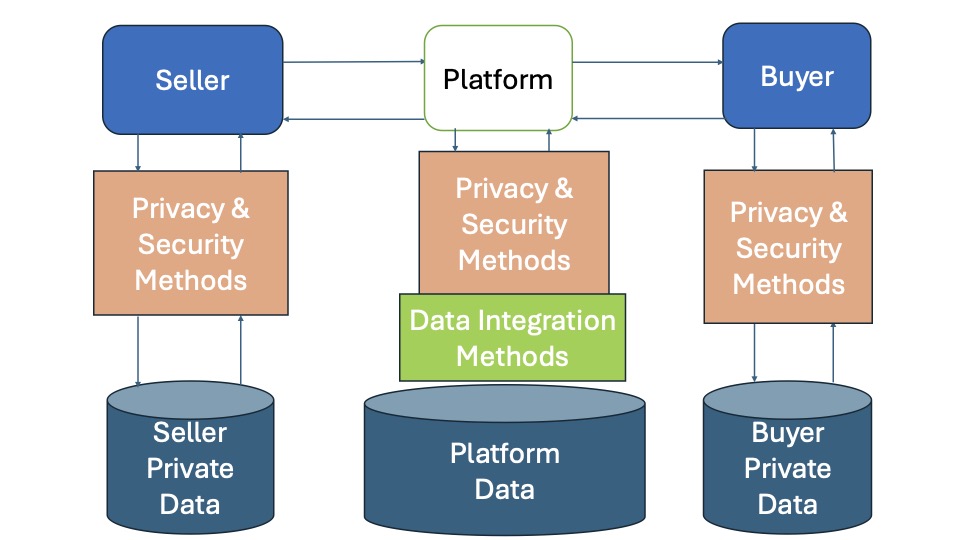
At SIGMOD 2025, my collaborators and I are scheduled to give a tutorial on Privacy and Security in Distributed Data Markets. The core material that will be presented is summarized in the accompanying paper.
Abstract

Data markets play a pivotal role in modern industries by facilitating the exchange of data for predictive modeling, targeted marketing, and research. However, as data becomes a valuable commodity, privacy and security concerns have grown, particularly regarding the personal information of individuals. This tutorial explores privacy and security issues when integrating different data sources in data market platforms. As motivation for the importance of enforcing privacy requirements, we discuss attacks on data markets focusing on membership inference and reconstruction attacks. We also discuss security vulnerabilities in decentralized data marketplaces, including adversarial manipulations by buyers or sellers. We provide an overview of privacy and security mechanisms designed to mitigate these risks. In order to enforce the least amount of trust for buyers and sellers, we focus on distributed protocols. Finally, we conclude with opportunities for future research on understanding and mitigating privacy and security concerns in distributed data markets.

Schedule

Part I: Survey on Data Markets

Part II: Privacy and Security Risks

Part III: Privacy-Preserving Technologies and Security Tools

Part IV: Regulatory Considerations

Part V: Open Problems & Future Work

Part VI: Q & A

Leading up to the conference, I’m planning to post on different aspects of the tutorial.

Fall 2025: Topics in Information-Theoretic Cryptography

Since the beginning of this year, I have been developing a course on “Topics in Information-Theoretic Cryptography”. Recently, the course was approved for Fall 2025. I’m very excited to share some research with undergraduate/graduate students! Below, I list some relevant information for the proposed course.

Course Number and Title

ECE598DA: Topics in Information-Theoretic Cryptography

Description

In this course, we will study foundational and recent work on the use of information theory to design and analyze cryptographic protocols. We will begin by studying privacy attacks which motivate strong privacy and security definitions. Then, we will explore the basics of differential privacy and study some core works on zero-knowledge proofs. Finally, we will explore various applications, including watermarking of generative models.

Recommended Textbooks

  • Introduction to Cryptography with Coding Theory. By Wade Trappe, Lawrence C. Washington.
  • Tutorials on the Foundations of Cryptography. Edited by Yehuda Lindell.

Syllabus

Week 1: Introduction: motivations, one-time pad review, review of probability theory

Week 2: Attacks and Composition Theorems for Differential Privacy

Week 3: Standard Mechanisms for Differential Privacy

Week 4: Information-Theoretic Lower Bounds for Differential Privacy

Week 5: Differentially Private Statistical Estimation and Testing

Week 6: Zero-Knowledge Proofs

Week 7: Statistical Zero-Knowledge Proofs: Part I

Week 8: Statistical Zero-Knowledge Proofs: Part II

Week 9: Multi-Party Computation

Week 10: Multi-Party and Computational Differential Privacy

Week 11: Code-Based Cryptography: Part I

Week 12: Code-Based Cryptography: Part II

Week 13: More Applications

  • Watermarking of Generative Models
  • Proof Systems for Machine Learning
  • Bounded-Storage Cryptography
  • Quantum Cryptography

Week 14: Project Presentations

Eigenvalues and Laplacian of a Graph: A Useful Lemma

Recently, for one of my projects I have been using the Laplacian matrix to study the spectra of graphs. For this post, I’ll review a tiny bit of background material on matrix theory for spectral graph theory. The majority of the material in this post can be found in the survey by Chung (1997).

What is the significance of eigenvalues and the Laplacian in understanding the properties and structure of graphs? Below, we highlight examples that show a connection between graph eigenvalues and the geometric aspects of graphs.

The Laplacian

Let G be a graph with vertex degree denoted by d_v for vertex v. Consider the following matrix L:

The Laplacian matrix \mathcal{L} is then defined by \mathcal{L} = T^{-1/2}LT^{-1/2}, where T is the diagonal matrix with (v, v)-th entry having value d_v. (This definition of the Laplacian is for graphs without loops and multiple edges.)

Examples

Examples of special graphs and the eigenvalues of their Laplacians:

  1. The star graph S_n on n vertices has eigenvalues 0, 1 (with multiplicity n-2), and 2.
  2. For the complete graph K_n on n vertices, the eigenvalues are 0 and \frac{n}{n - 1} with multiplicity n - 1.
  3. For the path P_n on n vertices, the eigenvalues are 1 - \cos\left(\frac{\pi k}{n-1}\right) for k = 0, 1, \ldots, n - 1.

Basic fact about the spectrum of a graph

Lemma (e.g., see Lemma 1.7 in [1]):
For a graph G on n vertices, we have:

  1. \sum_i \lambda_i \leq n with equality holding if and only if G has no isolated vertices.
  2. If G is connected, then \lambda_1 > 0. If \lambda_i = 0 and \lambda_{i+1} \neq 0, then G has exactly i + 1 connected components.
  3. The spectrum of a graph is the union of the spectra of its connected components.

Exercise for the reader: Can you rewrite the lemma in terms of the Laplacian?

[1] F.R.K. Chung. Spectral Graph Theory. Conference Board of Mathematical Sciences. American Mathematical Society, 1997.

